How Do You Serve 10,000 Customers With Two Telesales?
Building a refinancing aggregator's customer acquisition function from zero — custom CRM, automated qualification, and IDR 2 billion disbursed in the first 40 working days.
Context
Beeja Indonesia is a refinancing aggregator connecting borrowers to multifinance lending partners. It entered the market with a deliberately lean model: where traditional aggregators deploy hundreds or thousands of field agents to source customers, Beeja would operate through telesales.
I was brought in to build the customer acquisition function from nothing. No CRM, no qualification flow, no reporting infrastructure, no operating process.
The starting position:
- A database of roughly 10,000 potential customers, supplied by leasing partners and replenished in fresh batches as each was worked through
- A company of five people, of whom two were telesales
Far more customers than the team could ever contact.
The Constraint, and the Reframe
At 100 customers per day and ~10 minutes each, working the database conversationally would require more than 16 hours of talk time daily — before callbacks, WhatsApp threads, document collection, partner submissions or reporting. And most of that effort would be spent before knowing whether a customer had any interest in refinancing at all.
The obvious answer was to hire more telesales. For an early-stage company, that scales the inefficiency rather than solving it.
So rather than asking how can two telesales make more calls?, I asked:
How do we make sure telesales only ever call customers worth talking to?
The constraint wasn’t call capacity. It was that humans were positioned too early in the funnel.
Most of a refinancing conversation is repetitive screening — is there an active loan, is it mature enough, is there a real need for liquidity, is now the right time. None of that requires a salesperson. What requires a human is objection handling and helping someone commit to a financial decision.
Automate repetition. Preserve humans for persuasion and judgment.
What I Built
I built Beeja a custom CRM as the single source of truth for the entire operation — not a sales pipeline bolted onto spreadsheets, but the company’s operating layer. Written end-to-end with Claude Code in VS Code.
The lifecycle it runs:
- Database
- Automated Outreach
- Intent Capture
- Automated Qualification
- Qualified Lead
- Human Telesales
- Application
- Multifinance Partner
- Disbursement
Automated top of funnel. Permission-aware WhatsApp Business outreach at roughly 500 customers per day, with predefined intent responses — interested now, interested later, not interested. Opt-outs suppress immediately. At that volume, deliverability and quality-rating management is an operational requirement, not an afterthought.
Deliberately narrow qualification. Only 3–5% of the database reaches a human. The filter screens for loan maturity — refinancing isn’t viable before roughly 50% of installments are paid — and for genuine liquidity need. This is the most important design decision in the system: the two variables that normally kill a refinancing deal are eliminated before a salesperson spends a minute.
Structured disqualification. A cancel-reason taxonomy routes non-converting leads back into appropriate follow-up cycles, with certain reasons triggering permanent DND suppression. The list gets healthier over time rather than more exhausted.
Beyond acquisition. Because five people can’t afford tool sprawl, I extended the same system to application progress, partner submissions, sales reporting, performance dashboards, attendance and internal HR.
Beeja CRM · Admin dashboard
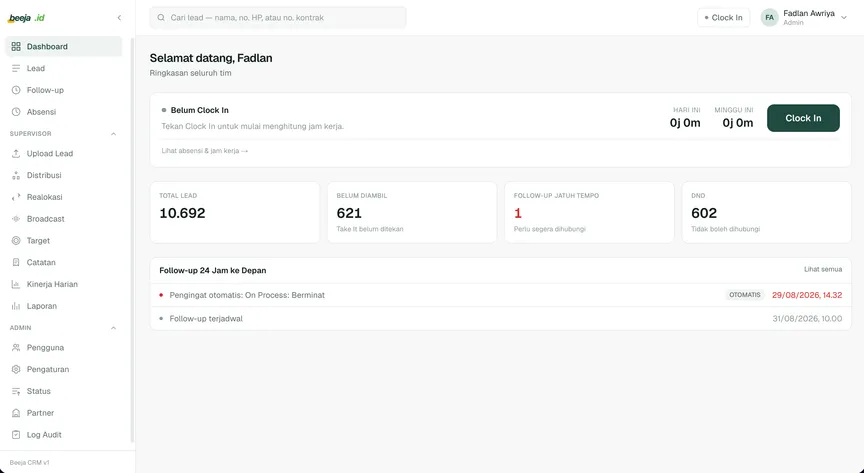
- 1Telesales backboneDistribution, reallocation, broadcast and daily targets — the queue two telesales actually work.
- 2CRM10,692 records in one database. Only 3–5% of them ever reach a human.
- 3HRISClock-in, attendance and internal HR run in the same system. Five people cannot afford tool sprawl.
Capture once. Automate where possible. Make it visible to everyone who needs it.
Supply. Leasing partners replenish the database in ~10,000-record batches. I paired that with independent top-of-funnel through SEM and social — including a website rebuild with analytics and search visibility activated — so acquisition wasn’t wholly dependent on partner supply.
Results
Soft launch June 2026, official launch July.
| Disbursed, first 40 working days | IDR 2 billion |
|---|---|
| Average disbursement | IDR 120 million |
| Revenue per disbursement | 7–9% |
| Customer acquisition cost | 1–2% of disbursement value |
| Revenue-to-CAC ratio | ~4–9x |
| Contribution margin | ~75–85% |
The funnel, per ~10,000-record batch:
- ~500 contacted per day, automated
- 3–5% qualify — the deliberate constraint
- ~10 qualified leads reach telesales per day (peak 20)
- Qualified to disbursed currently ~4–5%, trailing
That last figure understates steady state. Refinancing carries a document-collection and partner-approval lag, so leads qualified in recent weeks have not yet had time to close.
The operating result is leverage rather than volume: two telesales sustainably working a 10,000-record database, with automation absorbing everything up to the point where human judgment starts creating value.
More customers to more people became more customers to more automation to humans only where necessary.
My Role
Growth consultant, engaged for six months, owning the customer acquisition function end-to-end.
- Designed the operating model — funnel architecture, qualification criteria, lifecycle states, cancel-reason taxonomy
- Built the CRM myself — full stack, from schema to interface
- Built the automation layer — WhatsApp Business integration, intent capture, permission and suppression handling
- Owned top of funnel — website rebuild, analytics activation, search visibility, SEM and social acquisition
- Set the commercial model — CAC targets, revenue per disbursement, partner submission flow
Learning
Automation isn’t valuable because it removes people. It’s valuable because it makes human time worth more.
The apparent constraint was manpower — 10,000 customers, two telesales. Adding headcount would only have scaled an inefficient process.
The better question was which parts of the customer journey actually deserve human attention. Screening for loan maturity doesn’t. Convincing someone to refinance their vehicle does.
The principle I’ve carried forward:
Don’t automate the entire journey. Automate until human judgment becomes valuable.