Building the Operating System Behind Rp975 Billion in Used-Car Financing
Broom Leasing Channeling grew 6x in 16 months. I built the no-code system that carried the volume — and the commercial lever that changed what each transaction was worth.
Context
Broom Indonesia is an automotive financing technology company working to democratize finance in Indonesia’s used-car market. Broom Leasing Channeling (BLC) is its credit-channeling business: connecting used-car dealers to multiple multifinance lenders through a single integrated submission and transaction process, so a dealer submits once instead of negotiating separately with each lender.
I’ve owned BLC’s growth systems since launch in November 2023.
Where it started and where it got to:
| Nov 2023 | Mar 2025 peak | |
|---|---|---|
| Monthly transactions | 73 | 422 |
| Monthly GMV | Rp 9B | Rp 57B |
Roughly 6x growth in 16 months, with a cumulative 7,323 transactions and Rp975.2 billion in GMV across the period — an average ticket of about Rp133 million.
What I Owned
Worth being precise, because credit-channeling growth is a shared outcome.
The commercial team generated the GMV. Field sales acquired and worked the dealer network.
I built the system that carried it, and the lever that changed its value:
- The operating system every transaction ran through — built solo
- The funnel model and dashboards that made dealer productivity visible
- The margin-mix initiative that changed revenue per transaction
The Operating System
Used-car credit channeling isn’t a form. Each application crosses dealers, customers, commercial, operations, finance and multifinance partners, with documents, validations, statuses and handoffs at every step. Without a structured platform, the alternative was fragmented spreadsheets, manual follow-ups and no reliable view of where anything stood.
A custom engineering build would have taken quarters we didn’t have. So I translated the business process into two applications on Glide, and shipped both myself: a back office where operations, finance and partner submission run, and a mobile-optimised app for the field sales team working showrooms.
What that required was business translation, not tooling:
- Surfaces — a desk for the back office, a phone for the field
- Users — who submits, reviews, approves, monitors
- Actions — what each role must complete at each stage
- Data — customer, vehicle, dealer, financing, transaction
- Statuses — how an application moves from submission to disbursement
- Rules and validations — what’s required before anything advances
- Handoffs — when ownership moves between sales, ops, finance and partners
I built both, iterated on operational feedback, and maintained them as requirements changed.
The split is by role, not by feature. A field agent submits from the showroom floor — showroom, loan and vehicle detail on one customer — and tracks their own numbers under Achievement; a manager signing into the same app can onboard new agents from it. Back office picks the ticket up from there and works it through to Siap Cair, opening customer, showroom and disbursement detail on any ticket, with its own performance under Chart.
Broom Leasing Channeling · Glide
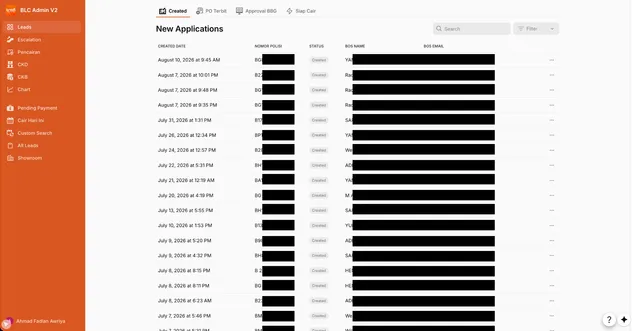
Back office
Every ticket a field agent submits, worked through to Siap Cair.
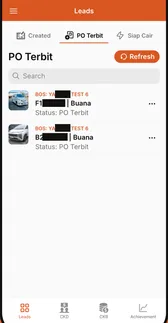
Field agent
Submitted from the showroom floor.
Customer and dealer names, plate numbers and email addresses are removed from the source files.
It carried 7,323 transactions and Rp975.2 billion in GMV.
The point isn’t that no-code can scale. It’s that translating an operating model accurately matters more than the tool — and that shipping in weeks let us validate the real workflow against real transactions before committing engineering investment.
Network Size vs. Dealer Productivity
The stated growth hypothesis was that more dealer partners would produce more financing applications and more GMV. The network reached ~400 registered showrooms.
I refused to treat registration as the metric, and modelled the network as a funnel instead:
- Dealer acquisition
- Onboarding
- First submission
- Approval
- First transaction
- Repeat transaction
Then built showroom-, branch- and funnel-level dashboards against it.
What that surfaced:
- Over 80% of registered showrooms transacted at least once — acquisition and onboarding were working
- Only 20–40% transacted in any given month
- Only 40–60 showrooms were consistently active
So the constraint was never acquisition. It was repeat transaction. A network of 400 was, in practice, a core of 40–60 dealers doing the work.
That reframes the growth problem entirely: expanding the network adds first transactions, but the compounding value sits in dealer retention and frequency. Separating “how big is the network” from “how much is it producing” is what made that visible.
Changing What Each Transaction Was Worth
GMV growth was the commercial team’s outcome. Gross revenue was a different lever, and it was available to me.
Multifinance partners pay materially different margins per channelled transaction — from roughly Rp500,000 to Rp5 million. A 10x spread, invisible in GMV, which treats every transaction as equivalent.
Two moves:
- An incentive program built with the commercial team, structured to steer submission mix toward higher-margin partners
- A joint partnership proposal with those partners, sharing customer risk profiling to lift their acceptance rates — since steering volume only pays if the applications actually get approved
At 7,323 transactions, a Rp1 million shift in average revenue per transaction is worth roughly Rp7 billion. The mix, not the volume, was where that value sat.
My Role
Senior Growth Manager, reporting into Head of Growth and Head of Sales, with direct coordination into Finance.
Team — five direct reports:
- Growth Associate, who led business operations across the entire commercial team
- Growth Analyst
- 3 Operational Admins, processing applications through to finance disbursement
Owning the ops admin function meant owning part of the transaction pipeline itself — application processing sat between dealer submission and disbursement, and it was mine.
Working across Sales, Product, Operations, Finance and multifinance partners.
Learning
Growth metrics and value metrics are not the same metric.
BLC’s headline story was network expansion and GMV. Both were real. But the two things that actually shaped the business sat underneath them: a 400-dealer network was really a 40–60 dealer network, and a 10x margin spread meant transactions were not interchangeable.
Neither was visible until the funnel was modelled properly and the revenue mix was separated from the volume.
Build the system that makes the business legible. The leverage shows up once you can see it.