What If Every House Was a Show Unit?
How I turned secondary-property inventory into staged show units — lifting property visits 5x and booking conversion from 5% to 20%, on a staging budget worth 1.5% of the asset.
Context
Pashouses was an early-stage Indonesian proptech, around 12 people at the time, operating an instant-buy model for secondary homes: acquire directly from sellers who valued speed and liquidity, then resell to end buyers. Average asset value was roughly IDR 1 billion, with a target gross margin of 20% and realised margin typically landing at 10–15% after buyer negotiation.
The go-to-market flow was linear:
- Acquire
- List
- Advertise
- Property Visit
- Booking
- Sale
We published inventory on our own marketplace and pushed it through digital and social channels.
One bottleneck sat in the middle of that funnel.
Problem
People were seeing the houses. They just weren’t visiting them.
Despite continuous promotion, property visits stayed flat at roughly 10–15 visits per unit per month. Booking fees — real money, IDR 10–20 million depending on transaction size — came in at about one per unit across a property’s entire time on market.
More marketing would generate more impressions and more listing views. It wasn’t going to solve the behaviour we actually needed: getting prospective buyers through the front door.
For a purchase at this consideration level, the physical visit was the conversion point that mattered.
Question
The instinctive reframe was how do we advertise these houses harder?
I started somewhere else:
Why would someone want to visit one of our houses in the first place?
Looking at the inventory, the experience was purely transactional. We acquired a secondary house, photographed it in its existing condition, published the listing, and expected buyers to imagine everything the house could become. Nothing in the funnel helped them make that leap.
Insight
My background is in architecture, which led me to compare our model against how primary developers sell new homes.
Developers routinely sell properties before the building physically exists. Buyers can still experience the product through a show unit — a designed, furnished environment demonstrating not just dimensions, but the life someone could have inside it.
Secondary property had the opposite advantage. The house was already there. We were treating it as inventory rather than as an experience.
Primary developers weren’t selling square meters. They were selling an imaginable future.
So rather than competing with new developments on price, what if every Pashouses property carried the same show-unit experience?
Getting to Yes
Staging meant real capex — IDR 20–30 million per house, against dozens of houses, at a company of twelve. Cofounder approval was not going to come from a slide.
So I tested demand before asking for budget.
I ran two ad variants: one showing a house as-acquired, one showing a staged version. Then I went to the sharpest available audience — customers who had already visited a property in its original condition and not converted — and sent a WhatsApp campaign asking whether they’d return to see it renovated.
70% said yes. 20% didn’t respond. 10% declined.
That group had already seen the house and passed. Their yes wasn’t politeness; it was re-intent from people with revealed knowledge of the property. The budget was approved on that evidence.
Experiment
To validate before scaling, I ran a controlled pilot in a single area using four broadly comparable houses matched on characteristics and location.
2 treatment properties — renovated, styled and furnished as show units. 2 control properties — left in existing condition, marketed through identical channels.
Tracked across property visits, booking fees and sales progression.
Within the first two weeks, staged properties drew 20+ visits and 2 booking fees, against 3 combined visits for the untreated pair. Over a month, visits to staged properties reached roughly 40 with multiple booking interests attached.
The bottleneck wasn’t awareness. It was desirability.
Scale, and the Modular Model
The pilot changed how we prepared inventory:
- Acquire
- Improve
- Stage
- Merchandise
- List
- Visit
- Convert
But staging every house as a one-off decoration expense wouldn’t survive contact with the P&L. So I designed the interiors around a modular, plug-and-play system — adaptable layouts and furniture selections that could be struck down and reinstalled in another property with similar dimensions.
At the point of sale, buyers could take the house with or without the furniture. If they declined it, the set redeployed into the next unit rather than being written off.
Staging stopped being a per-listing cost and became a reusable merchandising asset.
Pashouses · Show unit staging
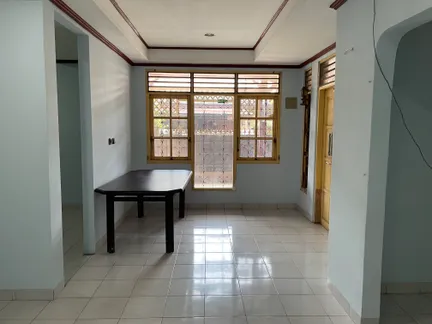
As acquired
Photographed and listed exactly as bought.
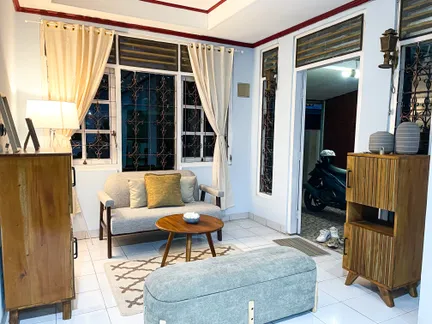
Staged as a show unit
Furniture specified to be struck down and reinstalled in the next house.
Results
| Before | After | |
|---|---|---|
| Property visits per unit, monthly | 10–15 | 60–80 |
| Booking fees per unit, across time on market | ~1 | 12–16 |
| Visit-to-booking conversion | ~5% | ~20% |
Booking fees were IDR 10–20 million each — buyers were committing roughly the entire cost of staging the house, individually. This was not a soft-interest metric.
Pashouses operated a queue system: multiple buyers could book the same property, and if the first in line secured bank approval, the sales team matched remaining queued buyers to comparable houses nearby. Approximately 50% of queued bookings converted to sales, with the remainder falling out on bank credit criteria rather than on intent.
The consequence: a single staged unit didn’t sell one house. It generated 6–8 closed transactions across the surrounding portfolio.
Unit Economics
| Initial staging per house | IDR 20–30M (furniture 60–70%, repaint and minor works the rest) |
|---|---|
| Redeploy cost | IDR 8–12M — roughly 60% cheaper than first install |
| Average furniture set lifespan | ~3 properties, until sold or broken |
| Effective cost per staged house | ~IDR 15M — about 1.5% of asset value |
Against a gross margin of IDR 100–150M per house, staging consumed roughly 10–15% of the margin on a single unit — while sourcing demand that closed 6–8 units.
The reusability was what made it defensible at board level. A one-off IDR 25M decoration expense per property is a marketing line item. A furniture set amortised across three houses, with the option to sell it into the transaction, is an asset.
Where the Constraint Moved
Half the queued bookings didn’t close — and the reason wasn’t desire. It was bank partner credit criteria.
That’s the correct outcome of fixing a real constraint: it moves. We had solved desirability at the top of the visit funnel, and the binding limit relocated downstream to financing eligibility. The next problem worth attacking wasn’t more visits or more staging; it was buyer credit-readiness and the partner mix underwriting them.
My Role
I owned this end-to-end — design, marketing, operations and unit economics, with budget approval from the cofounders.
- Directed an Ops Manager and Ops Associate as direct reports
- Acted as on-site project manager for the external renovation and furniture-install crews
- Led the Graphic Designer and Performance Marketer on listing and campaign output
- Owned the staging cost model, the modular redeploy system, and the margin case presented to the cofounders
At a 12-person company, this meant designing the intervention, proving it, staffing it, and defending its economics.
Learning
Not every growth problem needs more acquisition.
Low property visits looked like a marketing problem. The instinctive fix was more spend, more campaigns, more traffic into the listings.
The constraint was deeper in the experience. Customers could find our houses. They just weren’t excited enough to go see them.
And the leverage wasn’t only that desirability could be manufactured — it was that it didn’t have to be manufactured per unit. One staged house created demand distributable across the entire nearby portfolio.
The approach I’ve carried forward since:
Find the constraint. Understand the customer behaviour behind it. Build the smallest test that de-risks the spend. Measure. Scale what survives.